

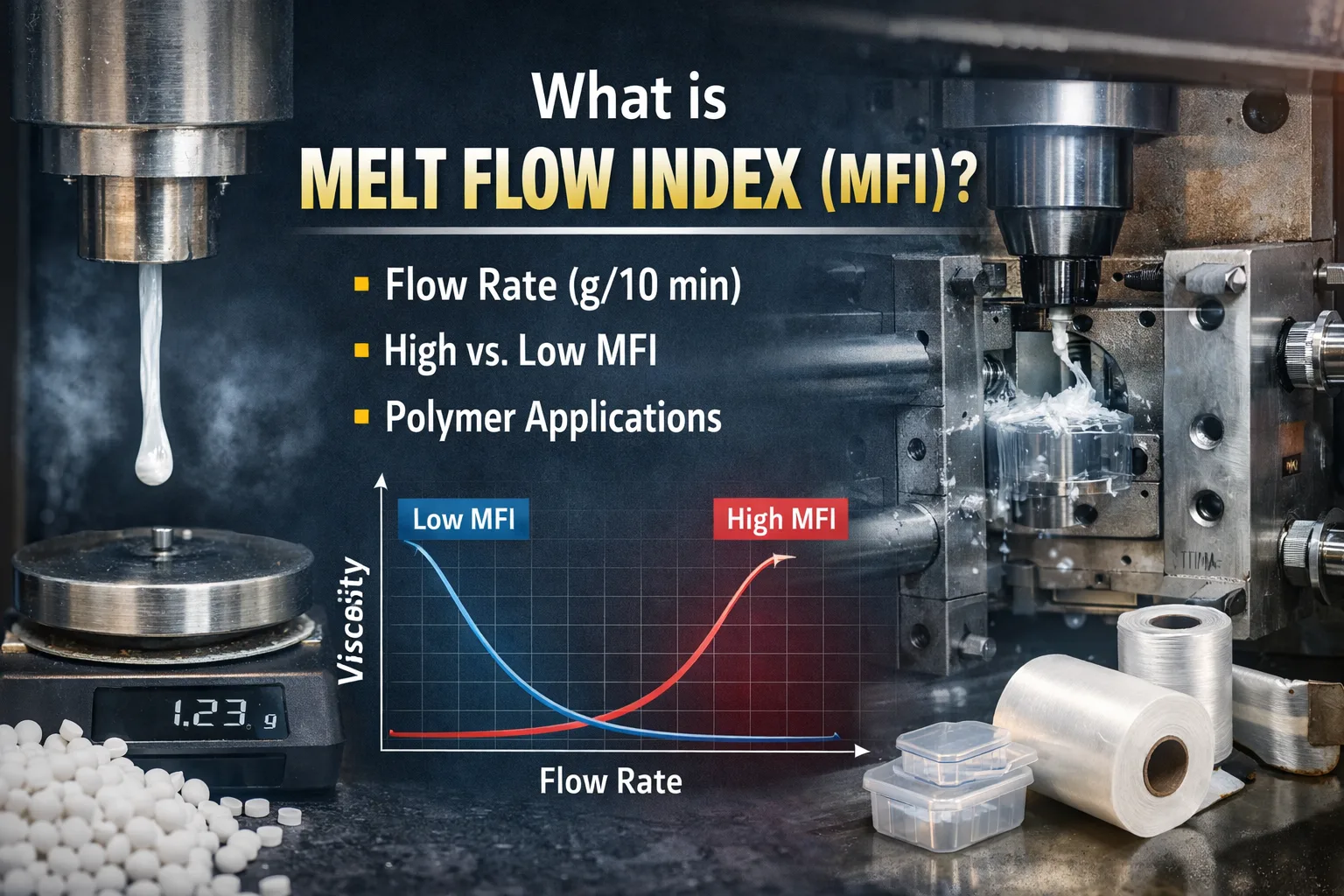
In the polymer and petrochemical industry, selecting the right material is critical for production efficiency, product quality, and long-term performance. One of the most important technical parameters buyers and manufacturers evaluate is the Melt Flow Index (MFI).
Understanding MFI helps international buyers choose the correct polymer grade for injection molding, film production, extrusion, fiber applications, and more.
What is Melt Flow Index (MFI)?
Melt Flow Index (also called Melt Flow Rate – MFR) measures how easily a thermoplastic polymer melts and flows under heat and pressure.
It is expressed in:
grams per 10 minutes (g/10 min)
The test determines how many grams of polymer pass through a standardized die under a specific temperature and load within 10 minutes.
In simple terms:
-
Higher MFI = Easier flow
-
Lower MFI = Higher viscosity and stronger molecular structure
Why MFI is Important for Buyers
Choosing the wrong MFI can result in:
-
Poor product quality
-
Processing difficulties
-
Higher production costs
-
Mechanical failure
For this reason, industrial buyers carefully match the MFI with their manufacturing process.
How MFI Affects Different Applications
1️⃣ Injection Molding
High MFI grades (e.g., 20–40 g/10min) are preferred for:
-
Thin-wall products
-
Complex molds
-
High-speed production
These grades flow easily and fill detailed molds efficiently.
2️⃣ Film Applications (PE & PP Film)
Lower MFI grades (e.g., 0.5–5 g/10min) provide:
-
Better strength
-
Higher durability
-
Improved puncture resistance
Used in:
-
Packaging films
-
Agricultural films
-
Industrial wrapping
3️⃣ Fiber and Raffia Applications
Medium MFI grades are commonly selected to balance:
-
Processability
-
Mechanical strength
-
Tensile performance
Applications include:
-
Woven bags
-
Industrial yarn
-
Geotextiles
MFI and Mechanical Properties
Generally:
-
Low MFI → Higher molecular weight → Stronger material
-
High MFI → Lower molecular weight → Easier processing
However, selecting the ideal grade requires balancing:
-
Strength
-
Flexibility
-
Impact resistance
-
Processing stability
MFI in Polyethylene (PE)
Different PE grades require specific MFI ranges:
-
HDPE Blow Molding → Lower MFI
-
LDPE Film → Controlled low MFI
-
LLDPE → Balanced MFI for flexibility
Correct selection improves product performance and reduces material waste.
MFI in Polypropylene (PP)
PP Injection Grades often range from:
3 – 40 g/10min
Higher MFI is preferred for:
-
Thin containers
-
Automotive parts
-
Household plastic products
Lower MFI grades are used where strength and stiffness are critical.
How Trueman Ensures MFI Accuracy
At Trueman, all polymer shipments undergo:
-
Laboratory verification
-
Technical specification confirmation
-
International standard compliance
-
Third-party inspection (SGS / BV upon request)
Each batch is supplied with documented product analysis to ensure consistency and reliability for global buyers.
Final Thoughts
Melt Flow Index is not just a number — it directly impacts manufacturing efficiency, product quality, and long-term durability.
For international buyers, understanding MFI ensures:
-
Proper grade selection
-
Cost efficiency
-
Reduced production risk
-
Reliable end-product performance
If you need assistance selecting the right polymer grade for your application, our technical team is ready to support your sourcing process.